Most guides on Japanese tattoo meanings get the first thing wrong. They treat a koi, a dragon, or a tiger like a sticker with a fixed translation, when the actual tradition works more like a visual grammar. In a proper irezumi composition, meaning comes from how the elements sit together, which way they move, what season they belong to, and what surrounds them.
That difference matters. A koi is not just a koi, a dragon is not just “power”, and a cherry blossom isn't only a pretty flower. In Japanese tattooing, the message lives in the arrangement, not the isolated icon, which is why a thoughtful consultation should start with the story you want the body to tell, not a flash sheet pulled from a wall.
If you want a broad visual reference before planning your own piece, Aloha Tattoo Waikiki Japanese traditional is a useful starting point for seeing how classic motifs are presented in a traditional style.

Why Japanese Tattoo Meanings Are Not What You Think
A common first question is, “What does this symbol mean?” That's understandable, but it's too simple for Japanese tattooing. A koi fish, dragon, or oni mask doesn't work like a dictionary entry with one clean definition, because the tradition is built around composition, not isolated symbols.
Meaning changes with direction and context
A koi swimming upstream usually reads as perseverance and ambition, while a koi swimming downstream can signal that the struggle has already been met or accepted. That same koi looks and feels different again when it's framed by waves rather than calm water. The background isn't filler, it changes the sentence.
The same is true for dragons. A dragon wrapped in clouds suggests wisdom and mastery, while a dragon positioned with water can sharpen the reading around control, protection, and natural force. If you want a good example of this kind of composition-led thinking, the structure shown in traditional Japanese ink art makes the point clearly.
Practical rule: don't approve a Japanese design until you've looked at the direction, the background, and the body placement together.
Many first-timers get caught out. They choose one motif they like, then discover later that the artist still needs to decide how it flows across the body. In Japanese tattooing, that flow is part of the meaning.
Why the design reads like a sentence
A single noun gives you almost nothing. A full sentence tells you who is acting, what's happening, and how the mood lands. Japanese tattoo meanings work the same way, because the central figure, the surrounding elements, and the direction of movement all contribute to the final read.
That's why the most useful question isn't “What does koi mean?” It's “What story is this koi telling, and what happens when it moves through the rest of the design?” Once you start reading tattoos that way, the whole style opens up.

The Historical Roots of Japanese Tattoo Symbolism
Japanese tattooing didn't begin as decoration. The historical record goes back to around 300 AD in written sources, and some accounts trace spiritual and decorative body marking in Japan to the Jōmon period, roughly 10,000 BCE (Nippon.com). That long history matters because the symbolism didn't arrive all at once. It accumulated layer by layer.
From spiritual marking to social control
At first, tattooing could carry spiritual and decorative significance. Later, during the Edo period, punitive tattooing was recorded from around 1720, which pushed body marks into the world of punishment and social judgement (Nippon.com). By the time the Japanese government banned tattooing in 1872, the art form had taken on strong associations with criminality and exclusion (Nippon.com).
That reversal is why modern Japanese-style tattoos can feel both beautiful and defiant. A peony can still suggest prosperity, a cherry blossom can still speak to the fleeting nature of life, and a koi can still stand for perseverance. But the tradition also carries the memory of being marked as outsider imagery.
Useful way to read the history: Japanese tattoo symbols gained depth because they lived through worship, punishment, and prohibition, not just fashion.
Why that history still matters in the UK
A UK client doesn't need to study Japanese social history to enjoy the style, but the background changes how the design should be handled. In the UK, where tattooing is culturally visible but still chosen carefully by many people, Japanese imagery works best when it's approached as a meaningful system rather than a random set of “lucky” icons. A 2014 questionnaire survey in Japan found 16 people with tattoos out of 1,000 respondents, showing how uncommon visible tattooing has historically been in the wider cultural context from which many of these motifs come (Nippon.com). That's part of why Japanese-style work still feels charged, even outside Japan.
For readers who want a broader design and heritage overview, traditional Japanese ink art offers another angle on how the style evolved.
Core Japanese Tattoo Symbols and Their Meanings
The easiest way to understand Japanese tattoo meanings is to stop thinking in single-word definitions and start thinking in combinations. The central motifs carry strong themes, but those themes shift when you change colour, direction, or pairing. That's why a good artist won't just ask what you like, they'll ask what you want the piece to say.
The motifs people ask about most
Koi fish are among the clearest symbols of resilience. Across multiple guides, they're linked with perseverance, determination, and transformation, especially through the image of swimming upstream. Some guides also note that red koi can suggest love and bravery, while black koi often represent overcoming hardship (Japanese Rituals).
Dragons are commonly tied to wisdom, protection, strength, and good fortune, with some readings also connecting them to mastery of the elements. Colour shifts the tone, too. Black dragons are often linked with wisdom, while blue or green dragons can lean towards nature and benevolence (Inked Magazine).
Tigers usually carry the language of courage and protection. They work well when the client wants a piece that feels grounded, sharp, and watchful.
Oni masks can read as guardianship, inner struggle, or the strength to confront difficult impulses. They're not just “demon faces”, they're protective and psychological at the same time.
Cherry blossoms point to impermanence and the fragility of life. Their power lies in how quickly they vanish, which makes them a natural contrast to heavier motifs.
Peonies are often associated with prosperity and honour. They're one of the most useful flowers in Japanese composition because they can soften a sleeve while still carrying weight.
Motifs and their core meanings
| Motif | Core Meaning | Key Variables |
|---|---|---|
| Koi fish | Perseverance, transformation, determination | Direction, colour, water setting |
| Dragon | Wisdom, protection, good fortune | Colour, pairing, background elements |
| Tiger | Courage, protection, strength | Pose, placement, surrounding nature |
| Oni mask | Guardianship, struggle, confrontation | Expression, colour, scale |
| Cherry blossom | Impermanence, fragility of life | Season, pairing, density |
| Peony | Prosperity, honour | Colour, placement, companion motifs |
The main thing to hold onto is simple. The symbol matters, but the variables matter just as much. If you change the context, you change the message.
How Background Elements and Composition Shape Meaning
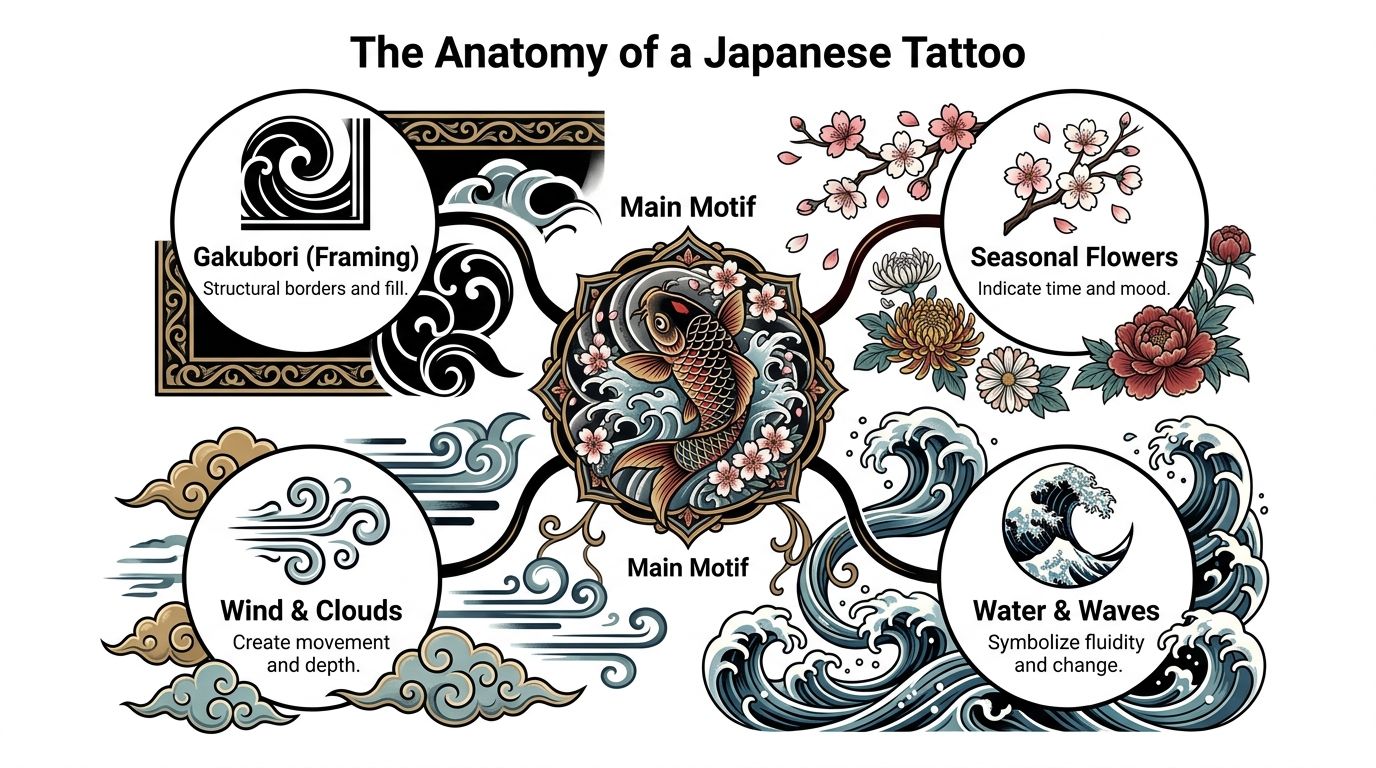
A Japanese tattoo without background is often unfinished in both design and meaning. The background system, known as gakubori, uses waves, wind bars, clouds, and seasonal flowers to frame the central figure and carry the story forward. It's structural, not decorative.
Background elements do the heavy lifting
Waves can make a koi feel more exposed, more active, or more hard-pressed against the current. Clouds can lift a dragon into a more spiritual or commanding space. Wind bars can create motion across the body so the design feels alive instead of pasted on.
This is why two tattoos with the same central motif can read differently. A koi with cherry blossoms suggests perseverance inside the reality of change and loss. A koi with crashing waves leans harder into struggle and endurance. The motif hasn't changed, but the sentence has.
If you're trying to visualise how these parts work together, the layout in The Anatomy of a Japanese Tattoo shows exactly why the framing matters.
Why artists ask about background before stencil work
A strong Japanese piece usually starts with the background system, because that tells the artist how to place the motif against the body. Shoulder, chest, back, thigh, and sleeve all create different flows, and the background is what connects those zones into one readable composition. Without that structure, the piece can look disconnected.
Reading test: if you removed the background, would the tattoo still tell the same story? If the answer is no, the composition is doing its job.
That's the difference between a custom Japanese tattoo and a generic flash pick-up. The first is built to move with the body. The second often just sits on it.
Cultural Sensitivity and Placement Considerations
The respectful approach to Japanese tattooing is not to avoid it. It's to treat it carefully, because the imagery comes from a living visual language with history, hierarchy, and social weight. A Japanese-inspired piece can be thoughtful and valid, but it should be designed with more care than a loose collage of symbols.
Appreciation looks different from appropriation
A sleeve built around a coherent narrative shows that you've paid attention to the system. A random mix of koi, masks, flowers, and dragons without any relationship between them can flatten the style into decoration. That's where people often cross from appreciation into confusion, even when their intentions are good.
The issue gets sharper when the design includes religious figures, folklore characters, or motifs with very specific cultural meanings. Those elements aren't interchangeable. If they're paired badly, the message can feel muddled or even backwards.
For a practical guide to how body flow affects design, your guide to good placement for tattoos is useful reading before you settle on size or location.
Placement changes the story
A sleeve reads like a journey because the eye travels with the arm. A small forearm piece reads more like a snapshot. Neither is wrong, but they don't carry the same narrative space. Japanese motifs often benefit from larger canvases because the composition needs room to breathe.
Scale matters for another reason, too. A tiger on a compact forearm can feel compressed if the background can't support it. A dragon on a back piece has room for clouds, flow, and directional tension, so the symbolism lands more naturally. That's why placement should be part of the meaning discussion from the start, not an afterthought.
Respectful choice: ask whether the design still makes sense if you change the body part. If it doesn't, the placement probably needs more work.
How to Commission a Custom Japanese-Style Tattoo
A good custom Japanese piece starts before anyone draws a line. You need a clear idea of the feeling you want, then you need an artist who can translate that feeling into the language of the style. Flash can give you a motif, but it won't give you a full sentence.
Start with meaning, not just imagery
Choose the core theme first. Maybe you want perseverance, protection, transformation, honour, or a sense of impermanence. Once you know the emotional direction, the motif choices get easier. A koi may fit one story, a dragon another, and cherry blossoms may work best as a balancing element rather than the centrepiece.
Then bring those ideas into consultation. Talk about direction, colour, season, and background. Those four decisions shape the read as much as the central image, so they should be discussed before any stencil is finalised.
Check the composition before ink touches skin
A proper review should answer a few basic questions.
- Does the main figure move in the right direction? Upstream, downward, left, or right all change the message.
- Do the background elements support the theme? Waves, clouds, and wind bars should add clarity, not clutter.
- Does the colour choice fit the intended tone? Colour can deepen or soften the symbolism.
- Does the piece work on this body part? A sleeve, chest panel, or back piece each tells the story differently.
- Can the design grow later if needed? Japanese work often benefits from planning ahead.
The best artists treat this as collaboration, not production. If you're looking for a UK studio context, Timebomb Bournemouth's Japanese tattoo shop is a good example of how a consultation-led approach can help match the right artist to the right project.

Start Your Japanese Tattoo Journey at Timebomb Bournemouth
The cleanest takeaway is this. Japanese tattoo meanings are built through composition, not through isolated symbols. Koi, dragons, tigers, masks, flowers, and backgrounds all work together, and the strongest designs are the ones that say something specific about the wearer, not just something popular.
If you're planning a first Japanese-style piece, keep these three things in mind. Direction changes meaning, background changes meaning, and placement changes meaning. Once those are handled properly, the design becomes personal instead of generic.
Timebomb Tattoo & Piercing is based at 109 Old Christchurch Road in Bournemouth, and it offers free consultations via online form or WhatsApp so you can talk through your idea before booking. The studio's resident and guest artists cover a wide range of styles, and flexible payment options include cash, card, and crypto. If you want to explore a Japanese sleeve, a smaller motif, or a larger custom concept, the right first step is a conversation.
If you're ready to turn your idea into a Japanese tattoo that fits your story, book a consultation with Timebomb Tattoo & Piercing. The team can help you think through motif, placement, and composition, then match you with the right artist for the piece you want.